
how to check car battery life without tools comes down to noticing a handful of reliable signs your car already gives you, if you know where to look.
If you only realize the battery is weak when the car won’t start, you’re already in the worst timing scenario: late for work, bad weather, or stuck in a parking lot. The good news is you can spot a struggling battery days or weeks earlier with quick checks that take minutes.
This guide focuses on practical, no-equipment methods: what to watch for at start-up, what your lights and electronics reveal, and what a quick under-hood look can tell you. I’ll also call out what these checks can’t confirm, because “battery vs alternator vs starter” confusion is where people waste time and money.
What “battery life” means in real-world terms
When people ask about battery life, they usually mean one of two things: the battery’s current charge (how full it is today) or the battery’s overall health (how much capacity it has left as it ages). Without tools you can’t measure voltage or cold cranking amps precisely, but you can still make a solid call on whether it’s acting normal, borderline, or near failure.
In many cases, the day-to-day problem is insufficient charge from short trips, cold weather, or a car sitting. Long-term, batteries lose capacity as plates degrade, and then even a “full” battery can feel weak.

According to AAA..., extreme heat and deep discharges can shorten a car battery’s usable service life, so a battery can “look fine” until it suddenly doesn’t.
Fast no-tool checks you can do in 3 minutes
If you want a quick read before a commute, these checks tend to surface weakness fast. You’re not looking for perfection, you’re looking for patterns.
1) Listen to the start: strong crank vs slow crank
A healthy battery usually gives a brisk, consistent crank. A weak battery often sounds slower, labored, or uneven, especially after the car sits overnight. One slow start can be a fluke, but two or three in a week is a message.
- Normal: steady “rrr-rrr” and it catches quickly
- Borderline: noticeably slower crank but still starts
- High risk: clicking, or it barely turns over before starting
2) Watch the headlights during start-up
At dusk or in a garage, turn headlights on, then start the car. Some dimming is normal during cranking, but a big dip that feels dramatic can point to low battery reserve.
- Small dip then steady: often okay
- Major dimming + slow crank: battery likely weak
- Lights brighten a lot after starting: can hint the alternator is working hard, but it’s not proof of anything by itself
One caution: modern LED headlights and smart power management can mask this, so treat it as a supporting clue, not the final verdict.
Under-hood visual checks (still no tools)
A quick look under the hood can reveal the “obvious” problems that make a decent battery behave like a bad one. If you’re unsure, keep the car off and avoid touching metal parts, and consider asking a shop for a quick check.
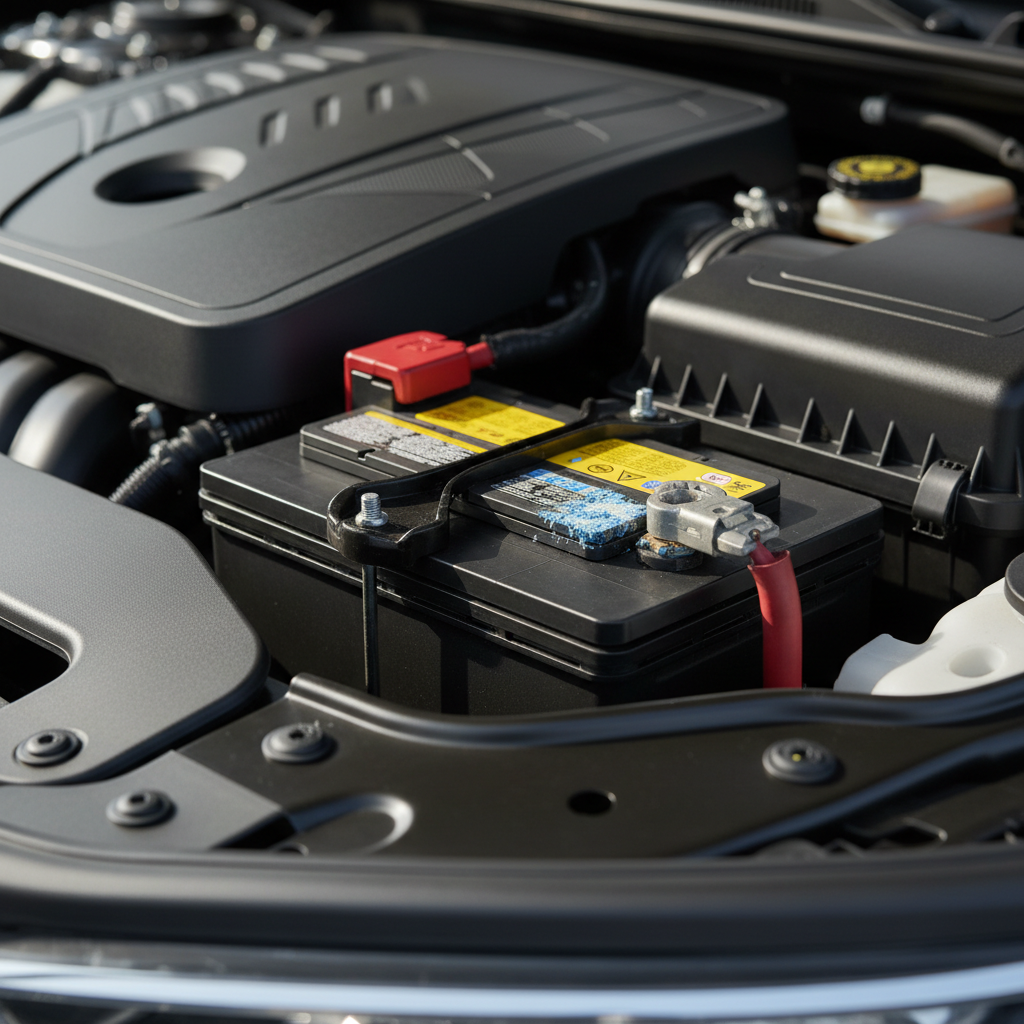
Corrosion, loose clamps, and dirty terminals
White/blue crust around terminals is corrosion and can create resistance, which mimics a weak battery. Loose clamps can do the same. A lot of “my battery is dying” reports are really connection issues.
- Look for crusty buildup at terminals
- Check if clamps look crooked or not fully seated
- Notice frayed cables or damaged insulation
Battery case condition and leaks
If the case looks swollen, cracked, or wet with fluid, that’s not a “monitor it” situation. Heat damage and internal failure become more likely, and replacement is often the safest choice.
Date/age clues
Many batteries have a sticker with a month/year or code. Age alone doesn’t condemn a battery, but it changes your decision-making. If it’s already several years old and showing weak-start symptoms, you don’t need many more clues.
What your car’s electronics can tell you
Cars are basically rolling electrical systems, and weak batteries show up as small annoyances before the no-start day.
- Slow power windows right after start
- Dim interior lights with the engine off
- Infotainment resets, clock resets, or random warning lights that clear later
- Remote key fob range feels shorter (sometimes the fob battery, sometimes vehicle voltage sensitivity)
According to NHTSA..., warning lights should be taken seriously, but they do not always mean the battery itself is bad; low system voltage can trigger multiple modules to complain.
Quick decision table: is it “okay,” “weak,” or “replace soon”?
This is the part most people want: a simple call you can make without a meter. Use the table as a practical shortcut, and if results feel mixed, treat the car as “weak” and plan a proper test.
| What you notice | Most likely meaning | What to do next |
|---|---|---|
| Starts strong, no dimming, no glitches | Battery likely OK today | Keep an eye on it, especially with heat/cold swings |
| Slow crank once after sitting, then normal later | Possible low charge or early weakness | Drive longer next trip, reduce short trips, re-check over a week |
| Slow crank repeatedly + noticeable headlight dip | Battery reserve likely low | Plan a free load test at an auto parts store, consider replacement timing |
| Clicking, no start, interior lights very dim | Battery may be discharged or failed | Jump start if safe, then get system tested (battery + alternator) |
| Cranks strong but won’t start | Often not the battery | Check fuel/ignition/security issues, get a diagnostic scan |
Step-by-step: a no-tool routine you can repeat weekly
If you’re trying to figure out how to check car battery life without tools in a consistent way, a short routine beats random guessing.
- Morning start check: listen for crank speed changes compared with your normal
- Light behavior: headlights on, then start, watch for major dip
- Electronics scan: do you see resets, flicker, or odd warnings?
- Visual glance (monthly): terminals clean, clamps tight-looking, no swelling
Write a quick note in your phone if you notice a slow crank. The trend matters more than the single event.

Key point: If you see two or more “weak” signals at the same time, treat it as actionable even without a meter.
Common mistakes that waste time (or cause misdiagnosis)
A battery check without equipment can still be useful, but people often over-trust one symptom and miss the real issue.
- Blaming the battery for everything: a failing starter can sound like a weak battery, and a bad alternator can drain a good battery.
- Ignoring corrosion: connection resistance can create slow starts even with a decent battery.
- Judging only after a long drive: right after driving, the battery may seem “fine” because it’s freshly charged.
- Assuming a jump start proves the battery is bad: sometimes it was just discharged; you still need a system test to know why.
According to Consumer Reports..., periodic electrical system checks can help prevent surprise failures, especially when a battery is older or the vehicle sees lots of short trips.
When to stop guessing and get a professional test
If any of these apply, a proper battery/charging system test is worth it, many auto parts stores offer it at no charge, and repair shops can do a deeper diagnosis if needed.
- You’ve had two or more slow cranks in a week
- The car needed a jump start more than once in a month
- You see swelling, leaking, or heavy corrosion
- The battery is older and you have upcoming travel, extreme weather, or long commutes
If you’re dealing with repeated no-starts, don’t keep cycling jump starts as a routine, it can be unsafe and may hide alternator or wiring problems. A technician can run a load test and charging test to separate battery health from alternator output.
Conclusion: the simplest way to avoid a dead-battery surprise
If you want a practical answer, how to check car battery life without tools is mostly about repeatable observation: crank sound, light behavior, and small electronic glitches, plus a quick visual check for corrosion and damage.
Your next step is simple: run the 3-minute check for a few mornings in a row, and if you see a pattern, schedule a free battery and charging system test before it becomes a stranded moment.
Key takeaways
- Trends beat one-off symptoms, track slow cranks across a week
- Corrosion and loose terminals can mimic a dying battery
- Two weak signals at once usually means it’s time for a real test
- If you’re unsure, a battery + alternator test prevents misdiagnosis
FAQ
How can I tell if it’s the battery or the alternator without tools?
Without a meter, you’re looking for patterns: if the car starts after a jump but dies later, or if you get repeated low-voltage weirdness while driving, the alternator becomes more likely. Still, confirmation usually needs a charging system test.
Do dim headlights always mean a bad battery?
Not always. Dimming can come from a weak battery, corroded terminals, or even normal behavior during cranking. It’s more meaningful when paired with slow crank and recent no-start events.
My car clicks once and won’t start, is the battery definitely dead?
A single click often points to low voltage, but it can also be a starter/solenoid issue or a poor connection. If interior lights are very dim too, the battery or connection is higher on the list.
Can short trips make my battery seem like it’s failing?
Yes, many short trips can leave the battery undercharged, especially in cold weather or with lots of accessories. A longer drive may help, but if the battery is aged, it may not recover fully.
What does corrosion on the battery terminal mean for battery life?
Corrosion usually signals acid vapor and chemical reaction at the connection, and it can reduce current flow. It doesn’t automatically mean the battery is near end-of-life, but it can cause starting problems even when the battery still has capacity.
Is it safe to keep driving with a weak battery?
Often you can drive, but the risk is getting stranded at the next restart. If the alternator is the real issue, you could also lose power while driving. If you notice repeated symptoms, it’s smarter to test soon.
How often should I check my car battery condition?
If the battery is newer and you have normal driving habits, a quick monthly glance plus paying attention at start-up is usually enough. If it’s older or you do lots of short trips, weekly quick checks are reasonable.
If you’re trying to avoid the “it won’t start” morning, a quick battery and charging system test, plus help choosing the right replacement group size and cold-cranking rating, can be a more stress-free path than guessing from symptoms alone.